Announcing Kyverno 1.17!
Announcing Kyverno Release 1.17!
Kyverno 1.17 is a landmark release that marks the stabilization of our next-generation Common Expression Language (CEL) policy engine.
While 1.16 introduced the "CEL-first" vision in beta, 1.17 promotes these capabilities to v1, offering a high-performance, future-proof path for policy as code.
This release focuses on "completing the circle" for CEL policies by introducing namespaced mutation and generation, expanding the available function libraries for complex logic, and enhancing supply chain security with upcoming Cosign v3 support.
A New Look for kyverno.io
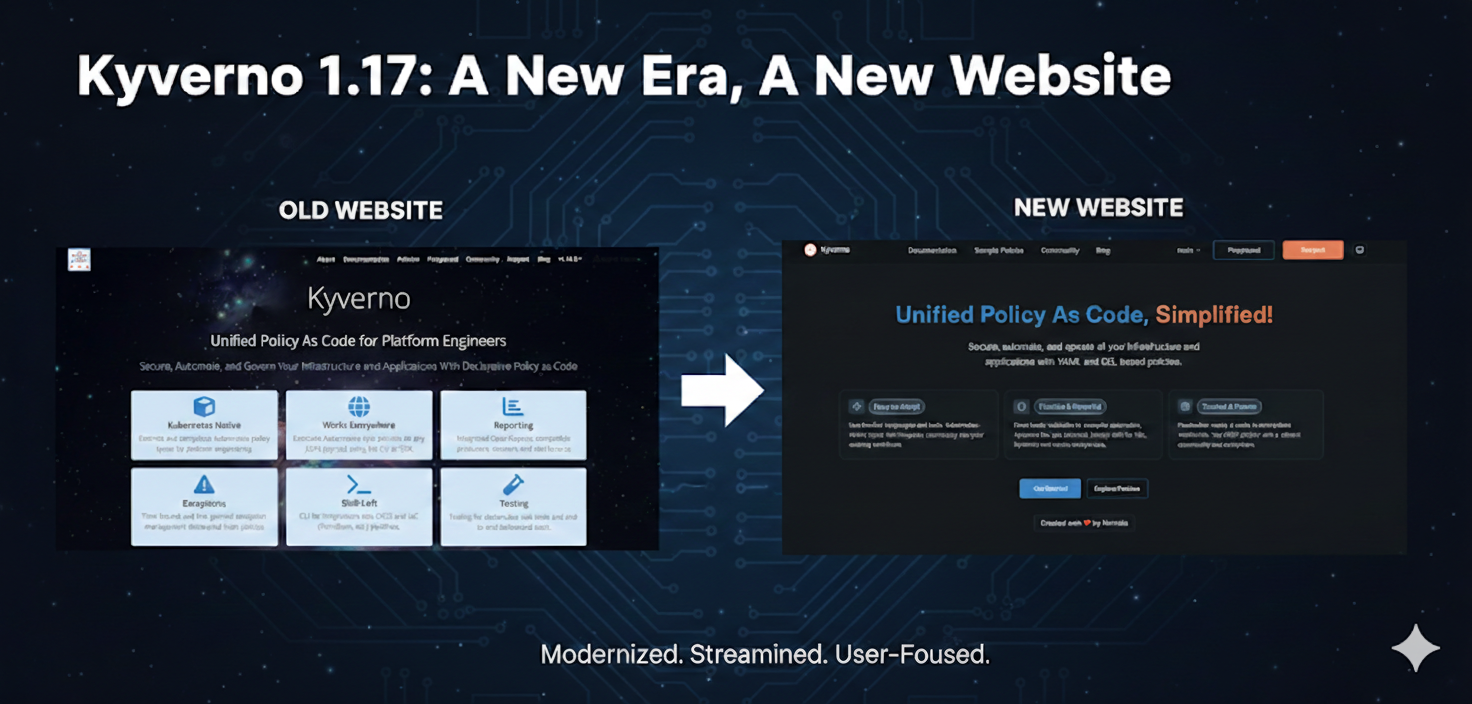
The first thing you’ll notice with 1.17 is our completely redesigned website. We’ve moved beyond a simple documentation site to create a modern, high-performance portal for platform engineers.
Let's be honest: the Kyverno website redesign was long overdue. As the project evolved into the industry standard for unified policy as code, our documentation needs to reflect that maturity. We are proud to finally unveil the new experience at https://kyverno.io.
-
Modern Redesign
Built on the Starlight framework, the new site is faster, fully responsive, and features a clean, professional aesthetic that makes long-form reading much easier on the eyes.
-
Enhanced Documentation Structure
We’ve reorganized our docs from the ground up. Information is now tiered by "User Journey"—from a simplified Quick Start for beginners to deep-dive Reference material for advanced policy authors.
-
Fully Redesigned Policy Catalog
Our library of 300+ sample policies has a new interface. It features improved filtering and a dedicated search that allows you to find policies by Category (Best Practices, Security, etc.) or Type (CEL vs. JMESPath) instantly.
-
Enhanced Search Capabilities
We’ve integrated a more intelligent search engine that indexes both documentation and policy code, ensuring you get the right answer on the first try.
-
Brand New Blog
The Kyverno blog has been refreshed to better showcase technical deep dives, community case studies, and release announcements like this one!
Namespaced Mutating and Generating Policies
In 1.16, we introduced namespaced variants for validation, cleanup, and image verification.
Kyverno 1.17 completes this by adding:
- NamespacedMutatingPolicy
- NamespacedGeneratingPolicy
This enables true multi-tenancy.
Namespace owners can now define their own mutation and generation logic (e.g., automatically injecting sidecars or creating default ConfigMaps) without requiring cluster-wide permissions or affecting other tenants.
CEL Policy Types reach v1 (GA)
The headline for 1.17 is the promotion of CEL-based policy types to v1. This signifies that the API is now stable and production-ready.
The promotion includes:
- ValidatingPolicy and NamespacedValidatingPolicy
- MutatingPolicy and NamespacedMutatingPolicy
- GeneratingPolicy and NamespacedGeneratingPolicy
- ImageValidatingPolicy and NamespacedImageValidatingPolicy
- DeletingPolicy and NamespacedDeletingPolicy
- PolicyException
With this graduation, platform teams can confidently migrate from JMESPath-based policies to CEL to take advantage of significantly improved evaluation performance and better alignment with upstream Kubernetes ValidatingAdmissionPolicies / MutatingAdmissionPolicies.
New CEL Capabilities and Functions
To ensure CEL policies are as powerful as the original Kyverno engine, 1.17 introduces several new function libraries:
-
Hash Functions
Built-in support for
md5(value),sha1(value), andsha256(value)hashing. -
Math Functions
Use
math.round(value, precision)to round numbers to a specific decimal or integer precision. -
X509 Decoding
Policies can now inspect and validate the contents of x509 certificates directly within a CEL expression using
x509.decode(pem). -
Random String Generation
Generate random strings with
random()(default pattern) orrandom(pattern)for custom regex-based patterns. -
Transform Utilities
Use
listObjToMap(list1, list2, keyField, valueField)to merge two object lists into a map. -
JSON Parsing
Parse JSON strings into structured data with
json.unmarshal(jsonString). -
YAML Parsing
Parse YAML strings into structured data with
yaml.parse(yamlString). -
Time-based Logic
New
time.now(),time.truncate(timestamp, duration), andtime.toCron(timestamp)functions allow for time-since or "maintenance window" style policies.
The Deprecation of Legacy APIs
As Kyverno matures and aligns more closely with upstream Kubernetes standards, we are making the strategic shift to a CEL-first architecture.
This means that the legacy Policy and ClusterPolicy types (which served the community for years using JMESPath) are now entering their sunset phase.
The Deprecation Schedule
Kyverno 1.17 officially marks ClusterPolicy and CleanupPolicy as Deprecated.
While they remain functional in this release, the clock has started on their removal to make way for the more performant, standardized CEL-based engines.
| Release | Date (estimated) | Status |
|---|---|---|
| v1.17 | Jan 2026 | Marked for deprecation |
| v1.18 | Apr 2026 | Critical fixes only |
| v1.19 | Jul 2026 | Critical fixes only |
| v1.20 | Oct 2026 | Planned for removal |
Why the Change?
By standardizing on the Common Expression Language (CEL), Kyverno significantly improves its performance and aligns with the native validation logic used by the Kubernetes API server itself.
For platform teams, this means one less language to learn and a more predictable and scalable policy-as-code experience.
Note for Authors
From this point forward, we strongly recommend that every new policy you write be based on the new CEL APIs. Choosing the legacy APIs for new work today simply adds to your migration workload later this year.
Migration Tips
We understand that many of you have hundreds of existing policies. To ensure a smooth transition, we have provided comprehensive resources:
-
Our new Migration to CEL Guide provides a side-by-side mapping of legacy
ClusterPolicyfields to their new equivalents (e.g., mappingvalidate.patterntoValidatingPolicyexpressions). -
You can now begin moving your rules into specialized types like
ValidatingPolicy,MutatingPolicy, andGeneratingPolicy. You can see the full breakdown of these new v1 APIs in the Policy Types Overview.
Enhanced Supply Chain Security
Supply chain security remains a core pillar of Kyverno.
-
Cosign v3 Support
1.17 adds support for the latest Cosign features, ensuring your image verification remains compatible with the evolving Sigstore ecosystem.
-
Expanded Attestation Parsing
New capabilities to deserialize YAML and JSON strings within CEL policies make it easier to verify complex metadata and SBOMs.
Observability and Reporting Upgrades
We have refined how Kyverno communicates policy results:
-
Granular Reporting Control
A new
--allowedResultsflag allows you to filter which results (e.g., only "Fail") are stored in reports, significantly reducing ETCD pressure in large clusters. -
Enhanced Metrics
More detailed latency and execution metrics for CEL policies are now included by default to help you monitor the "hidden" cost of policy enforcement.
For Developers & Integrators
To support the broader ecosystem and make it easier to build integrations, we have decoupled our core components:
-
New API Repository
Our CEL-based APIs now live in a dedicated repository: kyverno/api. This makes it significantly lighter to import Kyverno types into your own Go projects.
-
Kyverno SDK
For developers building custom controllers or tools that interact with Kyverno, the SDK project is now housed at kyverno/sdk.
Getting Started & Backward Compatibility
Upgrading from 1.16 is straightforward. However, since the CEL policy types have moved to v1, we recommend updating your manifests to the new API version. Kyverno will continue to support v1beta1 for a transition period.
helm repo update
helm upgrade --install kyverno kyverno/kyverno -n kyverno --version 3.7.0
Looking Ahead: The Kyverno Roadmap
As we move past the 1.17 milestone, our focus shifts toward long-term sustainability and the "Kyverno Platform" experience. Our goal is to ensure that Kyverno remains the most user-friendly and performant governance tool in the cloud-native ecosystem.
-
Growing the Community
We are doubling down on our commitment to the community. Expect more frequent office hours, improved contributor onboarding, and a renewed focus on making the Kyverno community the most welcoming space in CNCF.
-
A Unified Tooling Experience
Over the years, we’ve built several powerful sub-projects (like the CLI, Policy Reporter, and Kyverno-Authz). A major goal on our roadmap is to unify these tools into a cohesive experience, reducing fragmentation and making it easier to manage the entire policy lifecycle from a single vantage point.
-
Performance & Scalability Guardrails
As clusters grow, performance becomes paramount. We are shifting our focus toward rigorous automated performance testing and will be providing more granular metrics regarding throughput and latency. We want to give platform engineers the data they need to understand exactly what Kyverno can handle in high-scale production environments.
-
Continuous UX Improvement
The website redesign was just the first step. We will continue to iterate on our user interfaces, documentation, and error messaging to ensure that Kyverno remains "Simplified" by design, not just in name.
Conclusion
Kyverno 1.17 is the most robust version yet, blending the flexibility of our original engine with the performance and standardization of CEL.
But this release is about more than just code—it’s about the total user experience. Whether you’re browsing the new policy catalog or scaling thousands of CEL-based rules, we hope this release makes your Kubernetes journey smoother.
A massive thank you to our contributors for making this release (and the new website!) a reality.